Nathaniel Apletree (1672-1730)
under construction
The following has been derived from Reginald's research notes:
Nathaniel's problems arose out of his marriage to a distant relative Elizabeth Apletree, who was the daughter of Thomas (1632-1692) and granddaughter of Thomas (1606-1666 & of the civil war).
An area of freehold land known as the Windsor Four Yard Lands in Deddington, had been left by Thomas (1606-1666) part in trust for his eldest son Thomas (1632-1692) for life, and then outright to Philip, a younger son by his second marriage to Margaret Babbington. Philip died in 1674 before he reached 21 and his inheritance went to his two sisters Jane and Lettice. Jane also died in 1674 before she reached her majority, but Lettice survived until 1676 when she was 24, having married Frances Henry Cary in 1667. The ownership of the land was then disputed by Carey and Nathaniel and Elizabeth. The Court of Chancery’s decision was that their case was not justified. Nathaniel then had to sell his lands in Deddington to defray the costs of the case. This he did in March 1703, to his uncle by marriage, Francis Henry Carey.
Chancery proceeding were instituted by Nathaniel and Elizabeth to get Elizabeth's inheritance from her father' will of 1692 from the executor of this will, George Carter. Nathaniel stated that he could not even get a statement of account. George Carter responded with an account to the court in 1700. In 1706, Elizabeth and her siblings complained that George Carter did not pay them the rents on their father's lands nor the lump sums on the sister's marriages. He answered that they had not paid the fines on the renewals of lease when they arose.
Ann Heyman's explains this complicated problem a bit further:
The Apletree family in Deddington had been through years of disagreement and wrangling over the wills of John’s father Thomas (1632-1692) and his father, also Thomas (1606-1666). The Windsor Four Yard Lands had been left by Thomas (1606-1666) part in trust for his eldest son Thomas, for life, and the rest outright to Philip, a younger son by a second marriage. Philip died before he reached 21 and his inheritance went to his two sisters Jane and Lettice. Jane also died before she reached her majority, but Lettice survived until she was 24, having married Frances Henry Carey.
Thomas (1632-1692) always considered that the lands were his, in fact he settled them on his children, John, Elizabeth, Frances and Barney, in his will of 1692. He had had three “marriages” and was known for his violence, double dealings and untrustworthiness. John, the only child of his first marriage to Hester Savage, realised he would not inherit the lands as early as 1685 but Elizabeth and her husband Nathaniel Apletree (a cousin)were pursued in the courts over the inheritance by Carey. Nathaniel wrote asking him to drop the case because he and Elizabeth were on “the Ready Road to beggary” but it proceeded and the Court of Chancery’s decision was that Thomas’s case was not justified. Nathaniel then had to sell his lands in Deddington to defray the costs of the case. This he did in March 1703, to his uncle by marriage, Francis Henry Carey.
This was the beginning of the slide in family fortunes
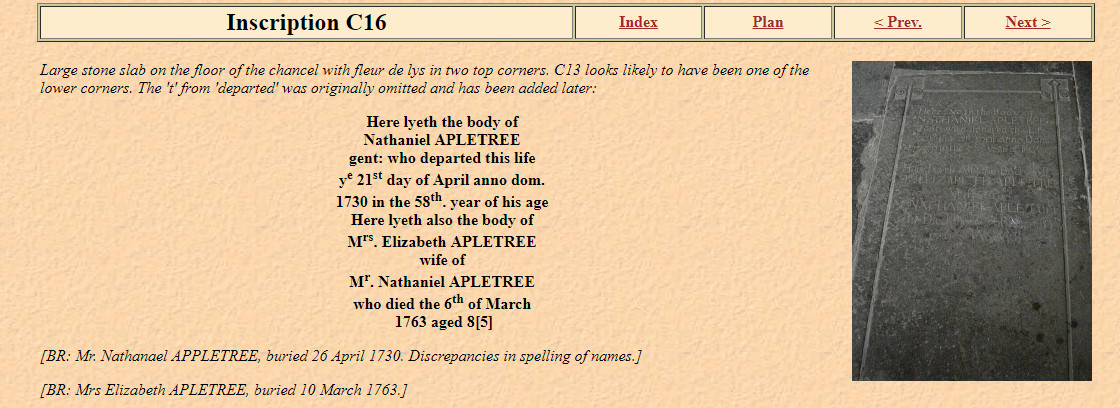
Nathaniel died aged 58 in 1730 and is buried along with Elizabeth (d.1763) in the churchyard