A Most Heinous and Traitorlike Fact
Ann Heymans
- Thomas Apletree
- A Most Heinous and Traitorlike Fact
In 1579 Queen Elizabeth 1st was at the height of her negotiations for a marriage with the French Duc d’Anjou. On July 17th the visiting French ambassador Simier, accompanied her in her barge on the Thames between Deptford and Greenwich when a shot rang out. Thomas Apletree, “a young man and servant and servant of Mr. Henry Cary, with two or three children of her Majesties Chappel, one other named Barnard Acton, being in a boat on the Thames, rowing up and down” had shot one of the Queen’s watermen clean through both his arms. The bargeman had been seated, rowing, only six feet away from Her Majesty. “The Queen’s Majesty showed such noble courage as is most wonderful to be heard and spoken of, her beholding him to be so maimed and bleeding in such sort she never bashed thereat but showed effectually a prudent and magnanimous heart, most courteously comforting the poor man. She bad him be of good cheer and said he should want for nothing that might be for his case, commanding him to be covered till such time as he came to the shore, in which time he lay bathing in his own blood.”
Thomas was arrested and taken to the Marshalsea prison from where he petitioned the Earl of Leicester for his release, claiming he had “inadvertently shot to the danger of the Queen.” From there on July 24th, he was taken through the city, with the Knight’s Marshal’s men (Henry Carey being the Knight Marshall for the day) to Tower Hill and thence on to Blackwall where a gibbet was set up close to the water’s edge. After Thomas’s lengthy confession and remorseful prayer “as the executioner as one greedy of his prey had put the rope around his neck, the people cried stay, stay, stay and with that came Sir Christopher Hatton Vice Chamberlain to her highness, enquired what he (Thomas) had confessed and being certified....he vailed his bonnet and declared that the Queen’s Majesty had sent him thither both to make the cause open to them how heinous and grievous the offence of the said Thomas Appletree was and further to signify to him her gracious pleasure.....The hangman was commanded to take the rope from” Thomas’s “neck, clean contrary to his expectation and ....(as was seen by the people) sorry to lose his prey.” Thomas “being come down the ladder received his pardon and gave God and his Prince praise for so great a benefit as he had had by her most gracious bounty received.
A lucky man....or was this a political cover up? The claim was that ”Thomas...had a caliver or arquebus which he had three or four times discharged with bullet shooting at randome verie rashly” and that the whole episode was an unfortunate, inadvertent accident. But why, if this were the case, was so much made of it... the Queen’s Vice Chancellor bringing the pardon...the Queen’s right hand man Leicester involved...the lengthy documents published for all to read? Thomas was employed by Henry Cary, but he was no ordinary servant or “lewd man” as the documents infer. He could read and write (as shown by his petition and prayer written whilst in prison), and how many novice gunmen or indeed any servant would be in possession of such a weapon, especially when the royal barge was close by? Henry was probably the son of Henry Lord Hunsdon, although there is very little documentary evidence of his life, Hunsdon being Elizabeth’s cousin at least and rumoured by some to be her half brother. He was a favourite of Elizabeth’s court and was patron of the Chamberlain’s men, an acting troupe including Shakespeare in its number. Although Hunsdon was favourably disposed towards the French marriage, Leicester and Hatton certainly weren’t. Was the young Henry Cary encouraged to give the Queen a bit of a fright, to show her how the people would react if she went any further with the marriage negotiations. There were other events in the summer of 1579 that gave out the same message. Henry was severely reprimanded for the event but since “he suffered in continual grief of his heart for the offence of his man” and since Thomas was willing to take the blame, he was able to pull some powerful strings to save his life. The Queen was able to benefit from the great show of her graciousness and mercy and Hatton and Leicester were able to show the Queen the folly of her marriage plans. Or was it a plot to rid the court of the French Ambassador, Simier who had usurped Leicester’s place as the Queen’s favourite – she called him “her Frog” and spent much time in his presence. It is possible that Simier also told Elizabeth that Leicester had secretly married Lettice Knollys. Whatever the reason the whole event was treated and publicised as an accident so that the planned visit of the Duc d’Anjou could go ahead without any alarm of security risk. Simier was given more bodyguards and the Duc arrived secretly in London in August. By November, despite outward appearances, Elizabeth realised she could not marry the French prince. She wrote to him “You realise, my dearest, that the greatest difficulties lie in making our people rejoice and approve”.
It is not clear which Thomas Apletree this “heinous traitor” was. It is probable that he was son of Simon, a salter in London who died only two years after Thomas was born in 1555. It may well have been that he and his mother then returned to the family home in Deddington where the Carys were the largest landowners in the area. In such circumstances Thomas could well have become Henry Cary’s servant. The other possibility is Thomas, son of Anthony, who was born in 1548, lived in Deddington and married Jane Warner. However he had inherited the family estate in 1577 after his father’s death and so was less likely to have been servant to Henry Cary. He was also a recusant being fined several times. These two Thomas’s were cousins, once removed.
Whichever Thomas it was, he could easily have changed the course of history.
“It liked her highness in respect of the great heat, to take the air of the water where in grave and weighty negotiation she passed the time in discourse with the French Ambassador by the space of an hour or two. In her return it pleased her to take diverse pauses....by means whereof (even as it pleased God with his holy hand, as it were, to direct her safety) she commanded the Bargemen to slack their labour, and slowly to pass on, where if they had hasted but two strokes more, they had brought her royal person into the shot itself”
Sources:
A brief discourse of the most heinous and traitorlike fact of Thomas Apletree.
Lambeth Palace library ref 1594-16/13
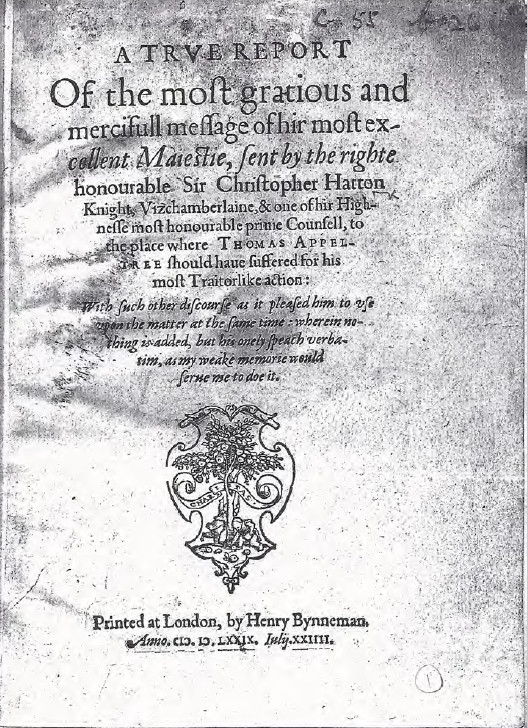
A true report of the most gracious and merciful message of her most excellent majesty, sent by the right Honourable Sir Christopher Hatton, knight, Vice Chamberlain and one of her Highnesses most honourable privy Counsell, to the place where Thomas Appletree should have suffered for his most Traitorlike action
British Library
Secret Memoirs of Robert Dudley, Earl of Leicester, Prime Minister and Favourite of Queen Elizabeth: Containing an Instructive Account of His Ambition, Designs, Intriques, Excessive Power ; His Engrossing the Queen, with the Dangerous Consequences of that Practice, &c. Written During His Life, and Now Published from an Old Manuscript Never Printed
Robert Parsons S. Briscoe, and sold, 1706